Pamm Infotech assists clients in streamlining their operations, boosting financial success, ensuring regulatory compliance, and elevating the overall satisfaction of patients.
Copyright 2026 Pamm Infotech Pvt. Ltd. | All Rights Reserved.
Revenue Cycle Management (RCM) is the backbone of financial performance in the healthcare industry. It is the end-to-end process that manages the flow of patient service revenue from the initial appointment scheduling and patient registration, through medical coding, billing, claims submission, payment posting, to denial management and final account resolution. An efficient RCM service ensures that healthcare providers maximize their reimbursements, reduce claim denials, and maintain compliance with regulatory standards. By integrating advanced technology, skilled professionals, and streamlined processes, RCM services help healthcare organizations focus on their core mission—delivering quality patient care—while ensuring financial stability and growth.
An efficient RCM service ensures that healthcare providers maximize their reimbursements, reduce claim denials, and maintain compliance with regulatory standards. By integrating advanced technology, skilled professionals, and streamlined processes, RCM services help healthcare organizations focus on their core mission delivering quality patient care while ensuring financial stability and growth.

Provider Office Upload Paper Work Through Different Platform
Intake Team Receive Paperwork and update WLT


Prior to claims being staged to claims scrubber application, we review the clams using the system functionality.
Automated claims editing to ensure that the claim data is accurate and manual edits as needed.
We review all claims throwing out from the clearinghouse systems and manually resolve.
Once the claims reach the payer, the claims are in denied or partially denied status and upon receipt of the information, we work with payers to refile claims.

Processing of payments made by Patients via cash/check/credit cards for co-pays, deductible, or for non- covered services.

Batch processing of electronic remittance advisory (ERA), and correction of any exceptions and transfer of balance to secondary insurers

Processing of payments made by insurance companies without ERA, and transfer of balance to secondary insurers

Posting of denials and re-billing to secondary insurance company, transfer the balance to the patient, write-off the amount, or send the claim for reprocessing
Once a batch is created, we are ready to post payment received under EOB batches. All the critical information is manually entered into the system against each account & DOS as per the Insurance EOB. Once, the batch has been adjusted with the payment amount/adjustment amount/patient responsibility we close the batch.
We post ERAs on a daily basis once we will receive them in the system from the payer end. ERAs we use to post are for till current date only and should be on ACH/Non Payment mode only. We did receive payments for the future date as well but do not use to post these ERAs in the current day and transfer the balance to secondary/tertiary insurance or onto the patient.
If the claim is denied, the payment poster enters the denials reason code on the particular DOS code and creates a task for the denial management team, and no need to transfer the balance to sec ins or onto the patient bucket.
We can track our processed work thru Reports. Reporting is a major part of the posting. After running reports, we have to verify that all the transaction which are coming up in the report is accurate and as per the requirement, guidelines and protocol everything is fine in the batch for which we have the report. Mainly after the completion of the Batch we use to run today’s Journals and Journal Summary.
Follow up with the insurance company to track the status of the claims
We identify denied claims, to analyze the reasons, follow-up with insurance company to check if additional information is needed and address the issues.
Refile the corrected claim to the insurance company and initiate follow up plan. At times, we may need to bill the secondary insurer.
Track the status of the claim with the insurer and follow-up till the claim is resolved.
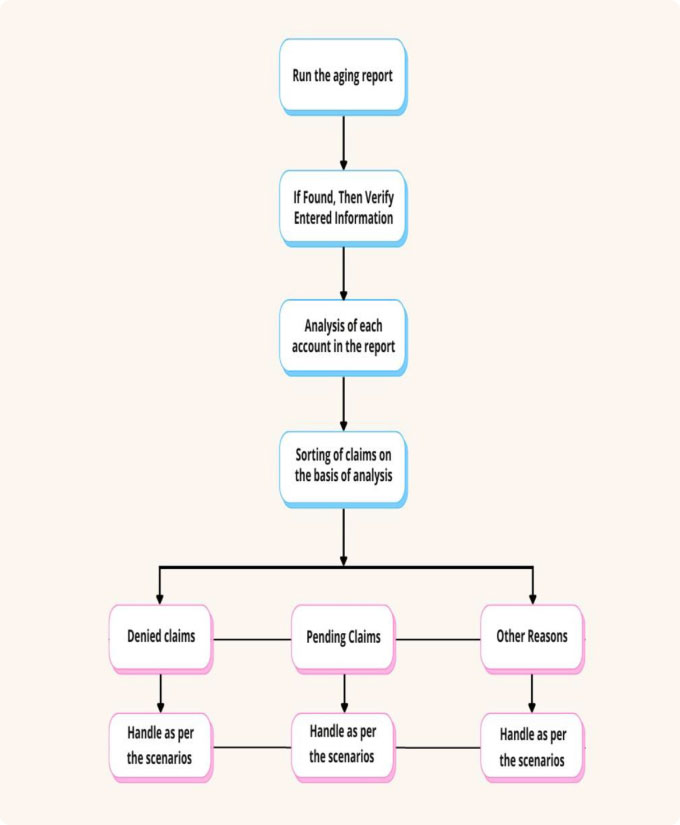
Follow up with the insurance company to track the status of the claims

We identify denied claims, to analyze the reasons, follow-up with insurance company to check if additional information is needed and address the issues.

Refile the corrected claim to the insurance company and initiate follow up plan. At times, we may need to bill the secondary insurer.

Track the status of the claim with the insurer and follow-up till the claim is resolved.
Supervisor always encourage team to follow basic rules of follow before dialing to insurance company
Claim is in the process: – Called Ins Name @ Ins Number s/w Representative Name
Claim received to date
May I know how many days it may take to process the claim
If the received Date is more than 30 days then need to ask below questions
The reason for the delay
The patient is effective and termination date
How much time it will take to process the claim
May I know the claim#
May I know the call ref#

Generation of electronic statement and mailing to the patient.

We log into the practice management system and print the statements for onward mailing to the patients.